We have safely made it to Salt Lake City! We had some free time this morning to sightsee in Temple Square before we left for the Girl Scout Leadership Institute kickoff. It was awesome to see so many Girl Scouts in one place!
We still haven't broken up into "majors" yet, but we've heard some great speakers already. The keynote GSLI speaker was Dr. Tererai Trent, a champion for girls' education in sub-Saharan Africa, who was mentioned in one of my sister's earlier posts. Her speech was extremely motivating, and she encouraged us all to find our "big hunger," or the thing we want most, and stop at nothing until we obtain it because "it is achievable." Her personal story of rising out of poverty made her speech an emotionally-charged illustration of what girls and women can achieve with some help and a big passion.
The speaker at the opening ceremony was Alison Levine, author of the New York Times bestselling book On the Edge. Levine climbed Mount Everest twice within 8 years, reaching the summit on her second try. She applied climbing skills to life overall; teamwork, perseverance, and decision-making is important in being a leader but can keep be an issue of life or death on a mountain. She told us not to fear failure or backtracking, because "backing up doesn't mean you're backing down."
All in all, today was an amazing start to what I think will be a great convention. I can't wait to see where the rest of the week will take us.
Friday, October 17, 2014

Monday, October 13, 2014
#GirlWithABook
Hello!
I'm Lindsey. I'm a Senior Girl Scout and I'll be attending the Girl Scout Leadership Institute at the National Convention in Salt Lake City in just a few days. I, along with about 1500 other girls, will have the opportunity to learn about issues including:
This kind of feminism is the kind I am invested in, and this is why I'm looking forward to expanding my knowledge at the National Convention.
I'm Lindsey. I'm a Senior Girl Scout and I'll be attending the Girl Scout Leadership Institute at the National Convention in Salt Lake City in just a few days. I, along with about 1500 other girls, will have the opportunity to learn about issues including:
- basic needs
- gender equality
- healthy relationships
- inclusion and diversity
- self-image
- teen violence
- education
I'll be blogging about my experiences while on the trip, but I'd like to introduce myself first and explain why attending this convention will mean so much to me.
I've been a Girl Scout for over 10 years, but it wasn't until my 8th grade year that I became involved in feminism. I always knew that there were inequalities between men and women in society but they didn't seem very important to me. That changed in October 2012 when Malala Yousafzai was shot on her school bus by a member of the Taliban. She was targeted for her outspokenness about girls' education. She survived, though, and at 17 recently became the youngest recipient of the Nobel Peace Prize for her work.
I've been a Girl Scout for over 10 years, but it wasn't until my 8th grade year that I became involved in feminism. I always knew that there were inequalities between men and women in society but they didn't seem very important to me. That changed in October 2012 when Malala Yousafzai was shot on her school bus by a member of the Taliban. She was targeted for her outspokenness about girls' education. She survived, though, and at 17 recently became the youngest recipient of the Nobel Peace Prize for her work.
When I heard about this, I went online to research what happened and came across the Facebook page for the #GirlWithABook movement, led by Lena Shareef and Olivia Curl. Reading everything on that page launched me into the world of feminism.
I recently had the opportunity to talk to both of these amazing ladies about their own experiences in feminism and their movement. Both grew up in fairly liberal areas of the country, and had privileged upbringings. Neither was involved in feminism until college; Olivia said that she originally viewed feminists as "whiny people," and Lena was ambivalent towards the movement. In college, however, both met diverse groups of women who made them realize the importance of feminism and women's rights. "I realized that this is an important thing, not just in other countries, but also in the United States," Lena said.
It was also in college that Lena and Olivia met and started #GirlWithABook. At the time that Malala was shot, Olivia was studying abroad in rural Jordan, near the Syrian border. Lena was living in Michigan. They began ranting to each other over Facebook messages and came up with the idea to "collect pictures of girls with books because apparently that's scary to idiots like the Taliban." They began to do just that. What started as a small social media movement has led both of them to become more active in the fight for women's rights, and has even taken them to the United Nations where they met Malala. "Malala told us 'what you're doing is fantastic and you should keep doing it,' so who can argue with that?" Olivia said.
Their stories are important to me not only because it's what got me interested in women's rights, but also because they show that even if you think feminism is a dirty word right now, there is a place for everyone to learn and get involved in this movement. To quote d.a.s.:
Feminism, to me, means the absolute equality of men and women. Feminism means the absolute equality of all men and women...Feminism only will succeed when all people on earth are treated as equal human beings, each just as good as another.
This kind of feminism is the kind I am invested in, and this is why I'm looking forward to expanding my knowledge at the National Convention.
Friday, July 20, 2012
Half the Sky
I've started reading Half the Sky by Nicholas Kristof and Sheryl WuDunn. I suggest you read it, too. The documentary series will be released on PBS on October 1 and 2 and stars Gabrielle Union, Meg Ryan, Eva Mendes, America Ferrera, and many others. (I would like to throw a premiere party in the Birmingham area, if anyone is interested.)


Here is the trailer:
Tinogona (It Is Achievable)
We ladies at the Girls' World Forum had the honor of hearing the very inspirational Dr. Tererai Trent speak at our closing ceremony.
Tererai grew up in a village in Zimbabwe where girls were not encouraged to attend school. Still, she wanted an education. Now she is a PhD who has opened nine schools in Africa.
Check out her story in the two videos below:
This woman has such a giving heart. Her spirit is apparent in the way she talks, the way she moves. I applaud her for not only rising out of poverty, but for providing others with better educational opportunities.
Somebody has to break the cycle of poverty. It is achievable.
We're Home!
I've been home since Tuesday night and have been sleeping almost constantly. The Girls' World Forum was a wonderful, life-changing experience--but I'm exhausted! Now that I've gotten some rest, it's time to get moving again. We have a lot of work to do:
- 60% of girls experience violence in their lifetimes.
- 2/3 of illiterate adults are female.
- For every man with HIV, there are three HIV+ women.
- There are 60 million child brides (less than eighteen years old) worldwide.
- Someone dies every 3.6 seconds from hunger.
- 130 species go extinct every day.
- 1/3 of coral reefs are destroyed or severely damaged.
- Women's hourly wages are 15% to 22% lower than men's.
- 2/3 of the world's unpaid work is done by women.
- 21,000 children die of hunger every day.
But there is good news, too!
- There are 10 million Girl Scouts and Girl Guides around the world.
- There are 59 million Girl Scout alumnae.
C'mon, ladies (and gentlemen)! Let's band together and make a difference!
Tuesday, July 17, 2012
A Few Videos We Watched This Week
An Indian PSA about stopping domestic violence:
A seven-minute video about the United Nations' Millennium Development goals:
A video from WAGGGS's "Stop the Violence" campaign:
7 Ways to Lead a Political Life
A woman from the Athena Center for Leadership Studies talked to us on Saturday about the lack of women in politics. The more female leaders a government has, she says, the stronger their democracy. I have to agree with her. Women are approximately 50% of the population, so their representation in government should reflect that. I did not know that in Rwanda, women currently make up 56% of Parliament (woohoo!).
Here are her seven steps to living a political life:
- Follow the news.
- Attend civic and political events.
- Talk like a leader.
- Make something happen.
- Try. Fail. Try again.
- Run for office now.
- Listen to your followers.
When I get home, I may start watching the news and practicing my public speaking skills. I also want to make an effort to learn more about other cultures and world history. My Namibian roommate was talking about Apartheid, and I thought to myself, I should really know more about this than I do. If I want to understand what is going on in the world today, I have to learn what events led up to it. That is part of being a global citizen.
What about you? Are you living a political life?
Sunday, July 15, 2012
Forever Green
My posts are a little behind, so I guess I need to catch everyone up.
 |
| Dolphins! |
 |
| Here I am with my friends from New York, Florida, and Sweden. |
A major problem affecting the world today is deforestation. In Sumatra and Borneo, trees in the rainforest are cut down to produce palm oil. Palms produce more oil per acre than any other plant. While this industry is good for generating jobs, the logging is not always done in a sustainable way, causing orangutans to lose their homes.

Orangutans are not the only animals left homeless because of deforestation. Big cats are commonly effected. The endangered African Blackwood tree, often used by lions as a resting spot, is used to make clarinets, oboes, and piccolos. Jaguars' habitats are destroyed by soybean farming. There are fewer than 500 Amur Tigers left in the wild, and fewer than 50 Amur Leopards.
What is being done to help?
Roundtable on Sustainable Palm Oil (RSPO) is a non-governmental organization that encourages people to grow sustainable palms.
The Forest Stewardship Council (FSC) was established in 1994 to create sustainable forests. Products that carry their logo come from certified sustainable sources.
Look out for this logo next time you buy paper, toilet paper, or other products:

We also discussed water conservation and climate change. I had heard that the oceans are becoming more acidic, causing wildlife to die, but I never considered what that had to do with climate change. Excess carbon dioxide from the atmosphere falls into the ocean and mixes with other chemicals to form carbonic acid.
The most shocking image I saw at the zoo was this:
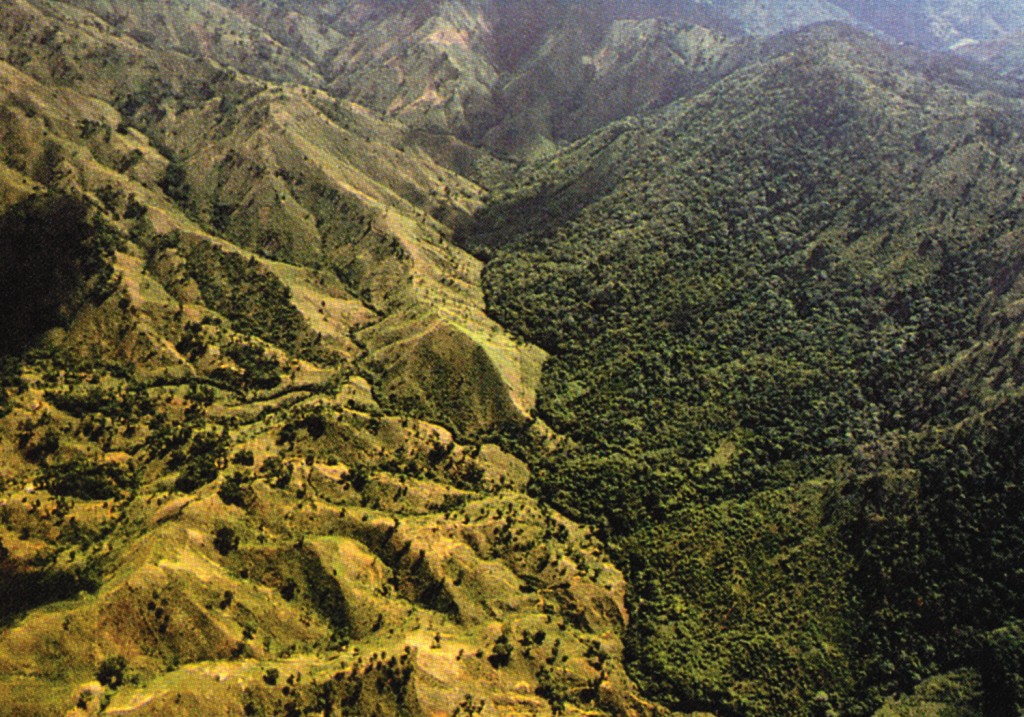
This is the border between Haiti and the Dominican Republic. Notice that Haiti on the left has few trees, while the Dominican Republic on the right is lush and green. The Dominican Republic regulates the logging industry; Haiti does not.
So does policy really matter? Absolutely.
On Saturday, I visited the Chicago Center for Green Technology. The property was formerly used as a dumping ground for old construction materials. Too much debris piled up, and the Department of Environment took over. Now the building is a model for what green living can be. Plants native to the Illinois area are grown outside, inside, on the roof, and on the walls of the building. Most everything is made from recycled materials. Their water is partially cooled by running it through pipes underground. The CCGT raises bees and collects their honey. If you ever happen to be in the Chicago area, I recommend you check the CCGT out. You may discover ways to make your own home more eco-friendly.
Saturday, July 14, 2012
POP QUIZ!
Can you figure out what these Australian things would be called in the United States?
- Singlets.
- Flannies.
- Thongs.
- G-Strings.
BONUS: What object do people in Wisconsin call "bubblers"?
Answers after the jump.
Today's Post is Brought to You by the Letter Zhe (Ж)
One of the coolest things about the Girls' World Forum is meeting girls whose cultures (and languages!) are different than my own.
My roommate, Beverly, is from Namibia. We spend hours discussing similarities and differences--scouting uniforms and time zones, electronics and wildlife, governments and money, morning songs and lullabies. She cannot believe that I have never seen the deer-like creature depicted on Namibian currency. "I bet you've never seen these animals," I say, showing her pictures of raccoons, possums, and armadillos. "They are so ugly!" she says. We laugh. They are ugly. "This one curls up into a ball?" "Yeah," I say. When she tells me her brother's hero is Abraham Lincoln, I give her the shiniest penny in my wallet and promise to give her a five-dollar bill the next time I get change.
Maria and Kate from Ukraine have been teaching me some Russian phrases. At first I felt silly when I mispronounce a word, but they understand how different our languages are and tell me to keep trying. I do. I feel amazing when I say the words correctly. I even practice saying the words while I'm in the shower.
These are only a few examples of the wonderful experiences I've had talking to people at this conference. If you want to foster understanding and acceptance in the world, all you have to do is get people from different cultures in one room together. This is what WAGGGS wants to achieve. Now that I have made friends from almost every continent, I want to make the world a better place for all of us.
Subscribe to:
Posts (Atom)