My posts are a little behind, so I guess I need to catch everyone up.
 |
| Dolphins! |
 |
| Here I am with my friends from New York, Florida, and Sweden. |
A major problem affecting the world today is deforestation. In Sumatra and Borneo, trees in the rainforest are cut down to produce palm oil. Palms produce more oil per acre than any other plant. While this industry is good for generating jobs, the logging is not always done in a sustainable way, causing orangutans to lose their homes.

Orangutans are not the only animals left homeless because of deforestation. Big cats are commonly effected. The endangered African Blackwood tree, often used by lions as a resting spot, is used to make clarinets, oboes, and piccolos. Jaguars' habitats are destroyed by soybean farming. There are fewer than 500 Amur Tigers left in the wild, and fewer than 50 Amur Leopards.
What is being done to help?
Roundtable on Sustainable Palm Oil (RSPO) is a non-governmental organization that encourages people to grow sustainable palms.
The Forest Stewardship Council (FSC) was established in 1994 to create sustainable forests. Products that carry their logo come from certified sustainable sources.
Look out for this logo next time you buy paper, toilet paper, or other products:

We also discussed water conservation and climate change. I had heard that the oceans are becoming more acidic, causing wildlife to die, but I never considered what that had to do with climate change. Excess carbon dioxide from the atmosphere falls into the ocean and mixes with other chemicals to form carbonic acid.
The most shocking image I saw at the zoo was this:
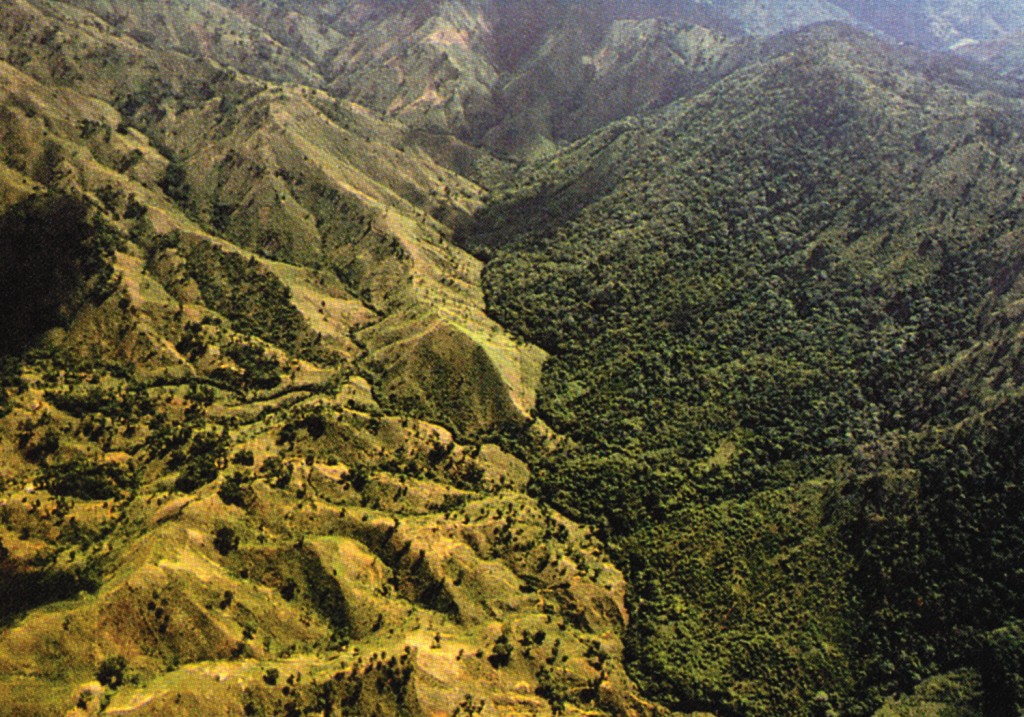
This is the border between Haiti and the Dominican Republic. Notice that Haiti on the left has few trees, while the Dominican Republic on the right is lush and green. The Dominican Republic regulates the logging industry; Haiti does not.
So does policy really matter? Absolutely.
On Saturday, I visited the Chicago Center for Green Technology. The property was formerly used as a dumping ground for old construction materials. Too much debris piled up, and the Department of Environment took over. Now the building is a model for what green living can be. Plants native to the Illinois area are grown outside, inside, on the roof, and on the walls of the building. Most everything is made from recycled materials. Their water is partially cooled by running it through pipes underground. The CCGT raises bees and collects their honey. If you ever happen to be in the Chicago area, I recommend you check the CCGT out. You may discover ways to make your own home more eco-friendly.

You are inspiring me! Mahatma Gandhi said “Be the change that you wish to see in the world.”
ReplyDelete